Why Your Fasting Window Gets Harder as the Mornings Get Darker
Quick Answer: Hunger timing is partly set by light. When sunrise moves later, your cortisol awakening response shifts and weakens, melatonin lingers longer into the morning, and the hormonal cue that normally suppresses early hunger arrives late or muted. The result is real morning hunger at a time that felt effortless in July. The fix is not more discipline - it is getting bright light early, shifting the window earlier rather than later, and accepting that a summer schedule and an autumn one do not have to be identical.
Your eating window has been 12 to 8 since spring. It never required thought. You drank coffee, got on with the morning, and ate when you got hungry, which was conveniently around noon.
Then somewhere in the last two weeks, 10:30am started feeling like a genuine problem.
Nothing about your metabolism broke. The sun is coming up around forty minutes later than it did a month ago, and your hunger clock is partly a light clock.

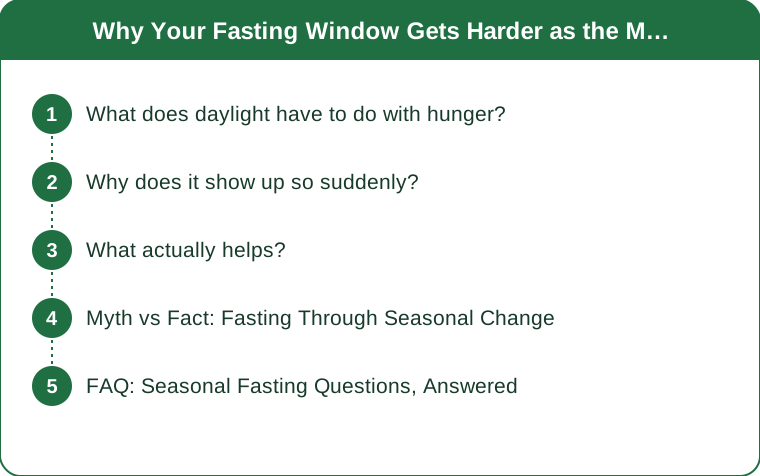
What does daylight have to do with hunger?
More than most fasting advice acknowledges, because appetite runs on a daily rhythm and light is what sets that rhythm.
The central clock in the brain is entrained primarily by light hitting the eyes in the morning. That clock then drives a cascade of downstream rhythms - including the hormones that govern when you feel hungry and when you do not.
Three of them matter here:
The cortisol awakening response. In the first thirty to forty-five minutes after waking, cortisol rises sharply. This is normal and useful - it mobilises stored glucose, which is a large part of why a fasted morning feels easy. A strong, well-timed cortisol response effectively suppresses early hunger. It is the thing doing the work when you think you are doing the work.
That response is amplified by light exposure. Waking in the dark produces a flatter, later, weaker version of it.
Melatonin clearance. Melatonin does not stop the moment you open your eyes - it declines over the following hour or two, and bright light accelerates that. A dark morning means melatonin lingers, which contributes to the specific fogginess that makes people reach for food.
Ghrelin timing. Ghrelin, the main hunger-signalling hormone, follows a learned daily pattern anchored to your habitual meal times and to your light cycle. When the light cycle shifts, the anchoring drifts.
The net effect: the hormonal profile that made a fasted morning comfortable in June arrives later and weaker in September. The hunger you are feeling at 10:30 is not imagined and it is not weakness.
Why does it show up so suddenly?
Because the change is not gradual in the way people assume, and because several things shifted at once.
Day length does not shorten at a constant rate. Around the equinox - late September - the rate of change is at its maximum, losing several minutes of daylight per day. Late August and September is the steepest part of the curve. In midsummer, a week changes almost nothing. Right now, a week changes a lot.
Then there are the behavioural changes that stack on top:
Schedules restart. School terms, work cycles, the end of holiday patterns. Wake times move earlier for a lot of people at exactly the moment sunrise is moving later, which widens the gap between waking and daylight considerably.
Sleep timing has usually drifted over the summer. Later bedtimes accumulate across warm months. Getting up at a fixed early time on a body clock that has quietly shifted later means waking further inside your own biological night - which flattens the cortisol response further.
Temperature dropped. Cooler ambient temperature genuinely increases appetite. Your body increases food-seeking when it needs to defend core temperature, and the first properly cool mornings of the year produce a noticeable jump in morning hunger for many people.
And morning routines move indoors. Coffee on the step in July becomes coffee at the kitchen table in September. That is a large difference in light exposure - outdoor light on an overcast morning is still many times brighter than a well-lit indoor room.
So it is not one change. It is four, arriving in the same fortnight, all pushing the same direction.

What actually helps?
Light first, then timing, then the eating window itself - in that order of leverage.
Get bright light within thirty minutes of waking. This is the highest-value intervention by a distance. Outside is best, even for five minutes and even under cloud. If it is genuinely dark when you wake, a bright indoor light or a light box is a reasonable substitute, but real daylight is much stronger.
Move the whole window earlier rather than making it shorter. If 12-8 has become difficult, 10-6 is very often easier than fighting for 12. Earlier eating windows are also better aligned with circadian glucose handling - insulin sensitivity is higher earlier in the day - so this is a change that costs you nothing and may help.
This is the point most people miss: the goal was never the specific clock times. It was the fasting duration and the metabolic effect. Both survive a shift.
Protect sleep timing above all. A consistent wake time, even at weekends, keeps the whole system anchored. A weekend drift of two hours produces a Monday morning where the hunger clock and the alarm clock disagree, which is the worst version of this.
Do not add caffeine to solve it. Escalating coffee to suppress morning hunger works briefly and costs the evening. Keep your normal amount.
Add protein and fat to the first meal. A first meal that is mostly carbohydrate produces a faster return of hunger, which makes the next morning’s fast harder. Protein-forward first meals reliably extend satiety.
And check your total intake honestly. Colder weather and a restarted schedule often mean more activity, and a fasting window built for a lower-activity summer may simply not be delivering enough food. Persistent, escalating hunger is often just underfuelling.
Myth vs Fact: Fasting Through Seasonal Change
Myth: If the fast got harder, you lost discipline. Fact: Hunger timing is hormonally regulated and light-entrained. A later sunrise produces a measurably different morning hormone profile. Treating that as a character problem leads people to abandon a schedule that only needed shifting by two hours.
Myth: The window has to stay at the same clock times to work. Fact: The benefits associated with time-restricted eating come from the duration of the fast and its consistency, not from any particular start time. An earlier window is at least as good and possibly better for glucose handling.
Myth: Morning hunger means your metabolism has adapted badly. Fact: Ghrelin is largely learned and anchored to habitual timing and light cues. When those cues change, it takes one to two weeks to re-anchor. Persistent hunger during that window is a transition, not a malfunction.
Myth: More black coffee is a free way to push through. Fact: It works acutely and it is not free. Escalating caffeine shifts your evening cortisol, costs you sleep quality, and worse sleep independently increases ghrelin and reduces leptin the following day - which makes tomorrow’s fast harder. It is borrowing.
Myth: You should fast longer to compensate for eating more in the cold. Fact: Extending the fast when you are already struggling with it is how people end up in a binge-restrict pattern. If appetite is genuinely up because activity is up, the answer is more food inside the window, not a longer window.
Myth: Everyone should keep fasting through the winter. Fact: For some people the schedule stops fitting their life once the season and routine change, and that is a legitimate reason to pause it. Time-restricted eating is a tool, not a commitment.
FAQ: Seasonal Fasting Questions, Answered
How long does it take to adjust to a shifted window?
Usually one to two weeks for ghrelin timing to re-anchor to a new schedule. The first three or four days are the hardest, and it improves fairly quickly after that. Making the change decisively - the same new times every day - adjusts faster than moving it around, because the hormone pattern is learning from repetition.
Should I just eat breakfast in the winter and fast in the summer?
That is a completely reasonable approach and more people do it than admit to it. Seasonal variation in eating patterns is normal historically and there is nothing about time-restricted eating that requires year-round consistency. What matters more is that whatever you do is sustainable and adequately fuelled.
Is the hunger real hunger or just habit?
Both, and they are hard to separate from the inside. A useful test: drink a glass of water, get outside or into bright light for five minutes, and reassess after fifteen minutes. Habit-driven hunger usually fades; genuine physiological hunger builds. If it builds and keeps building, eat - repeatedly overriding real hunger signals is not a skill worth developing.
General information, not medical advice. Fasting is not appropriate for everyone - including people who are pregnant, have a history of disordered eating, or have diabetes managed with medication. Speak to a clinician before making changes.
TL;DR:
- Hunger timing is light-entrained. A later sunrise weakens and delays the cortisol response that made your fasted morning easy.
- Late August to September is the steepest part of the daylight curve - the change is fast, not gradual.
- Four things stack at once: less morning light, restarted schedules, drifted summer sleep, and cooler temperatures raising appetite.
- Bright light within thirty minutes of waking is the highest-leverage fix. Then shift the window earlier, not shorter.
- Do not escalate caffeine to cover it - it costs you the sleep that makes tomorrow harder.
The schedule did not stop working. The sun moved, and the schedule can move with it.
Keep Reading
This article is for general informational purposes only and is not medical advice. Always consult a qualified health professional for guidance specific to you.