Does Coffee Break a Fast, and What Actually Matters?
Quick Answer: Black coffee does not break a fast under any common definition - it has 2 to 5 calories and no meaningful insulin response. A splash of milk technically does, and for most people fasting for weight management the effect is negligible. If you are fasting for a blood test, anything but water breaks it. If you are fasting for autophagy or gut rest, protein and calories matter more than the number. The honest answer is that the question only matters once you name the goal.
This is the most asked question in fasting and it gets answered as though there is one correct line. There is not, because breaking a fast means completely different things depending on why you are doing it.

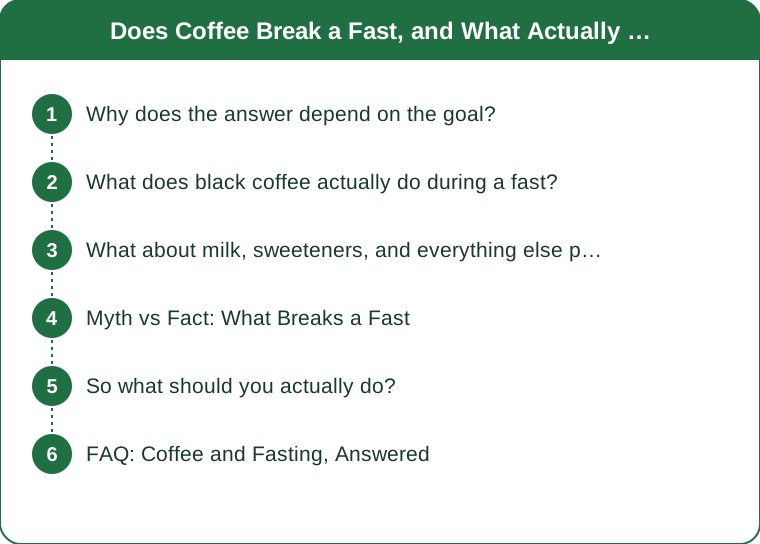
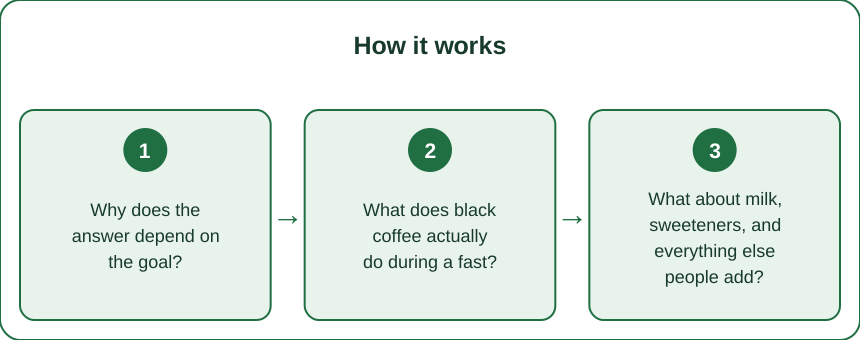
Why does the answer depend on the goal?
Because a fast is defined by what it is trying to achieve, and different goals are sensitive to different things.
If the goal is weight management through calorie restriction, then what matters is total calories. A 5-calorie black coffee is irrelevant. A 40-calorie splash of milk is nearly irrelevant. A 250-calorie oat milk latte is not a rounding error.
If the goal is metabolic - keeping insulin low - then what matters is the insulin response. Black coffee has essentially none. Protein produces a meaningful insulin response even without carbohydrate, which is why collagen and protein powders in coffee are genuinely different from milk.
If the goal is autophagy, the honest answer is that nobody can tell you precisely. Most human evidence is indirect, the thresholds are extrapolated from animal work, and confident claims about exact calorie limits are not well supported.
If it is a medical fast for a blood test, only water counts. No coffee, no tea, no chewing gum unless your clinic says otherwise.
If the goal is gut rest or reflux management, coffee may be a problem regardless of calories, because acidity and motility matter more than energy content.
What does black coffee actually do during a fast?
Almost nothing calorically. A cup of black coffee is 2 to 5 calories, which is below any threshold anyone proposes.
It slightly increases fat oxidation and metabolic rate. Caffeine has a modest thermogenic effect, which is why many people fast more comfortably with coffee than without.
It suppresses appetite genuinely. This is the main practical reason coffee is popular during fasting windows, and it is a real effect rather than a placebo.
It may modestly support autophagy rather than hinder it, based on some animal and cell work with coffee’s polyphenols, though this is preliminary and should not be treated as established.
On an empty stomach it hits harder. Caffeine absorbs faster with no food present, so the same cup produces more jitteriness and a higher heart rate response during a fast than it does after breakfast. Many people find they need less coffee, not more, when they start fasting.
And it can worsen reflux and stomach discomfort on an empty stomach, particularly for people prone to either. If black coffee at 7am makes you feel unwell, that is a common and legitimate reaction, not a failure of adaptation.
What about milk, sweeteners, and everything else people add?
A tablespoon of milk: around 8 to 10 calories. For a weight-management fast, negligible. For a strict metabolic protocol, it is a small amount of lactose and protein, so it is technically a break.
A splash of cream: 20 to 50 calories, mostly fat, minimal insulin response. This is the addition most tolerated by people fasting for metabolic reasons and the least tolerated by people counting calories.
Plant milks vary enormously. Unsweetened almond milk is around 3 calories a tablespoon; oat milk is several times that and contains readily absorbed carbohydrate.
Zero-calorie sweeteners: mostly fine, with individual variation. Sucralose and aspartame do not meaningfully raise insulin in most studies. Some people report increased appetite afterwards, which is worth noticing in yourself rather than assuming either way.
Collagen and protein powders break a fast for metabolic purposes, even at low calories, because protein triggers an insulin response and suppresses autophagy signalling. This is the most common thing people add believing it is neutral.
MCT oil and butter are calories without much insulin response. Whether that breaks your fast depends entirely on which goal you picked at the start.
Plain tea, herbal tea, and sparkling water: all fine under any definition except a medical fast.

Myth vs Fact: What Breaks a Fast
Myth: a single calorie breaks a fast. Fact: no threshold that precise exists in any evidence base. The commonly quoted 50-calorie limit is a practical rule of thumb, not a measured biological switch.
Myth: coffee will spike your cortisol and ruin the fast. Fact: caffeine does raise cortisol modestly, particularly in people who do not consume it regularly, and the effect diminishes with habitual use. It is not a reason to avoid coffee.
Myth: adding fat is free because it does not raise insulin. Fact: it does not raise insulin much, and it absolutely contains calories. For anyone fasting to reduce total intake, bulletproof-style coffee is not a neutral addition.
Myth: diet soda breaks a fast because of the insulin response. Fact: the evidence for a meaningful insulin response to common non-nutritive sweeteners is weak. The better reasons to limit them are individual appetite effects and gut comfort.
Myth: chewing gum is fine. Fact: fine for most fasting goals, not fine for a medical fasting blood test, and it does stimulate digestive activity which some people find increases hunger.
Myth: if you break your fast by 20 minutes, the whole thing is wasted. Fact: the benefits associated with time-restricted eating come from the pattern sustained over weeks, not from the precision of any individual day.
So what should you actually do?
Name your goal in one sentence, then apply the matching rule.
Weight management: keep the fasting window under about 50 calories and stop thinking about it. Black coffee, tea, a splash of milk if you want it. The precision people apply here is far beyond what affects the outcome.
Metabolic or blood sugar focus: black coffee, tea, water only. No protein, no milk, no sweetened anything.
Medical test: water only, and follow your clinic’s instructions exactly.
Whatever you choose, keep it consistent. Most of the benefit of time-restricted eating appears to come from consistency of the pattern, and a rule you actually follow every day beats a stricter one you follow four days a week.
And notice how the coffee itself makes you feel. Fasted caffeine is stronger. If you are getting jittery, anxious, or a racing heart in the morning since starting, reduce the dose rather than pushing through - this is one of the most common and most fixable problems people have in their first month.
Autumn adds one small thing worth knowing: fasting windows get harder as mornings get darker, and people often reach for more coffee to compensate. That is a light and sleep issue rather than a fasting one, and more caffeine tends to make it worse.
FAQ: Coffee and Fasting, Answered
Does black coffee break a 16:8 fast?
No. Under every common interpretation of time-restricted eating, black coffee is fine and is one of the main things that makes the window manageable.
What about a teaspoon of milk?
Technically yes, practically no for weight management. For a strict metabolic protocol, use it or do not, but be consistent rather than agonising over it.
Is coffee on an empty stomach bad for you?
For most people it is fine. For people with reflux, gastritis, or an ulcer, it can be genuinely irritating. If you feel unwell, that is a reason to eat first or switch to tea, not a sign you need to adapt.
Does decaf count?
It has the same negligible calories and none of the caffeine effects. It is a reasonable choice for anyone whose fasted caffeine response is uncomfortable.
This is general information, not medical advice. Fasting is not appropriate for everyone - including people who are pregnant, have a history of disordered eating, are on medication requiring food, or have diabetes - and should be discussed with a doctor in those cases.
TL;DR:
- Black coffee does not break a fast under any common definition, and it genuinely helps with appetite.
- A splash of milk is negligible for weight management and technically a break for strict metabolic fasting - pick a rule and be consistent.
- Collagen and protein powder do break a metabolic fast, which surprises most people who add them.
- For a medical fasting blood test, water only, no exceptions.
- Fasted caffeine hits harder, so if you have become jittery since starting, reduce the dose rather than pushing through.
The question has no universal answer because a fast is defined by its purpose. Name the goal in one sentence and the coffee question answers itself.
Keep Reading
This article is for general informational purposes only and is not medical advice. Always consult a qualified health professional for guidance specific to you.