Why You Feel Colder During a Fasting Window
Quick Answer: Feeling colder during a fast is mostly the missing thermic effect of food - digestion itself produces heat, and without it your baseline warmth drops - combined with reduced blood glucose availability and, in many cases, mild dehydration and lower electrolytes. It becomes much more noticeable in autumn because the ambient temperature falls at the same time. It is usually harmless, but persistent, severe, or new cold intolerance is worth getting checked.
Most people notice this for the first time in the first cool weeks of the year, decide fasting has stopped agreeing with them, and never find out that the temperature outside changed at the same moment.

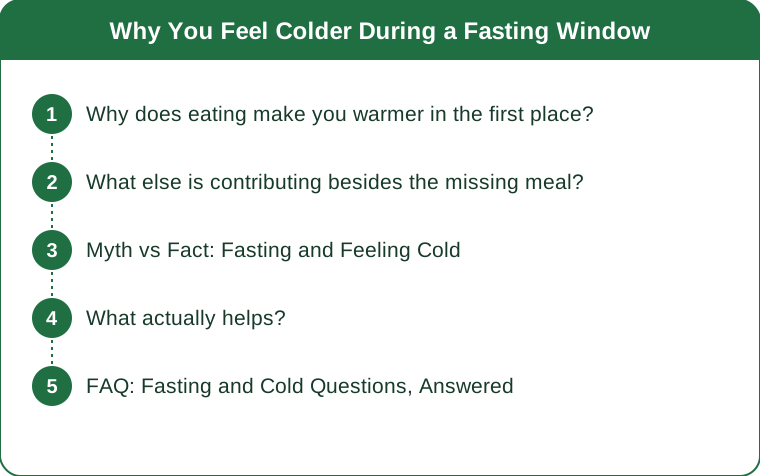
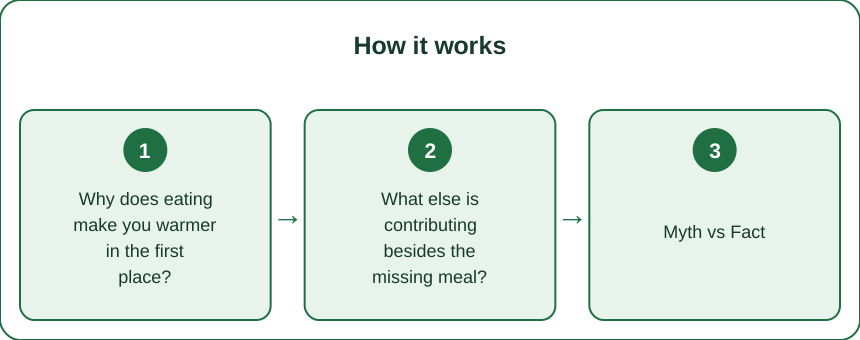
Why does eating make you warmer in the first place?
Digestion has a metabolic cost, and that cost shows up as heat. The thermic effect of food is the energy your body spends processing what you eat, and it accounts for roughly ten percent of daily energy expenditure for most mixed diets.
Protein has the highest thermic effect by a wide margin. This is why a protein-heavy meal can leave you noticeably warm, sometimes uncomfortably so, and why the warming effect of a light snack is much smaller.
During a fasting window, that entire contribution is absent. Your body is not generating that background heat, and the drop is real rather than imagined.
Blood flow patterns change too. Digestion increases blood flow to the gut. Without it, more circulation is available elsewhere, but the overall thermal sensation for most people is of being cooler rather than warmer.
And your body prioritises the core. When energy availability drops, peripheral blood flow to hands and feet is reduced first. This is why the sensation is almost always cold hands and cold feet rather than a general chill.
What else is contributing besides the missing meal?
Dehydration, which is extremely common during fasting windows. A large amount of daily fluid intake comes from food, and removing meals removes that without most people compensating. Lower blood volume means less efficient heat distribution.
Electrolytes go with it. Sodium, potassium, and magnesium all drop during extended fasting windows, particularly for people who also drink a lot of coffee or train fasted. Low sodium in particular is associated with feeling cold and lightheaded.
Caffeine on an empty stomach constricts peripheral blood vessels. Black coffee is the standard fasting drink, and it directly contributes to cold extremities in a way most people never connect.
Reduced movement matters more than expected. People often schedule fasting windows across their most sedentary hours, and sitting still is a substantial part of feeling cold.
And ambient temperature is the big confounder in autumn. A fasting routine that felt fine in August is being run in a house several degrees cooler in October. The fast did not change; the room did.

Myth vs Fact: Fasting and Feeling Cold
Myth: Feeling cold means your metabolism has slowed down. Fact: The missing thermic effect of food is not the same thing as metabolic slowdown. Short fasting windows do not meaningfully reduce resting metabolic rate, and some research suggests short-term fasting slightly increases it. The cold sensation is largely about heat production from digestion and about peripheral blood flow.
Myth: It means you are burning fat, so it is a good sign. Fact: There is no reliable relationship between feeling cold and fat oxidation. Treating the symptom as evidence of progress is how people talk themselves out of addressing something fixable.
Myth: Drinking more coffee will warm you up. Fact: The hot liquid warms you briefly; the caffeine works against you afterwards through vasoconstriction. Herbal tea or hot water gives you the warming without the counteracting effect.
Myth: You just need to tough it out and adapt. Fact: Some adaptation happens, but persistent cold intolerance is one of the more meaningful signals that a fasting protocol is too aggressive for you at present. Adaptation is not the answer to every symptom.
Myth: It affects everyone the same way. Fact: People with lower body fat, lower muscle mass, thyroid conditions, anaemia, or Raynaud’s phenomenon all experience this more strongly. Same protocol, meaningfully different experience.
What actually helps?
Salt your water, or take electrolytes. This is the single most effective fix for most people and it costs almost nothing. A pinch of good salt in water during the fasting window addresses the mechanism directly.
Drink more, and drink it warm. Herbal tea, hot water, broth if your protocol allows it. Volume and temperature both help, and warm drinks work better than cold ones for obvious reasons.
Move for two minutes every hour. Muscle contraction generates heat immediately. A few sets of calf raises or a walk to the kettle does more than an extra layer.
Layer for the room you are actually in. Wool socks and a warm layer during the fasting window is not a defeat, it is a reasonable response to producing less heat.
Move your window if the mornings are the problem. A window that ends at noon means your coldest hours are also your fasted ones. Shifting eating earlier so the fast falls in the evening, when the house is warmer and you are wrapped up anyway, solves it for a lot of people.
And shorten the window in winter if you need to. Twelve or fourteen hours through the coldest months instead of sixteen is a reasonable seasonal adjustment rather than a failure of discipline.
FAQ: Fasting and Cold Questions, Answered
When should I be concerned rather than adjusting?
If the cold intolerance is severe, persistent outside your fasting window, accompanied by fatigue, hair changes, unexplained weight change, or a very low heart rate, that warrants a proper conversation with a doctor rather than a tweak to your protocol. Thyroid issues, anaemia, and low energy availability all present this way and none of them are fixed by more discipline. This is general information, not medical advice.
Does this get better with time?
Partly. Most people report the first few weeks are the worst and it settles. But it also gets worse again every autumn, because ambient temperature is a large part of the equation. Expect a seasonal pattern rather than a one-time adaptation.
Should I stop fasting in winter?
Not necessarily, but adjusting is sensible. Shorter windows, more electrolytes, and shifting the window so the fasted hours are the warm ones are all reasonable. Some people simply find a shorter overnight fast fits winter better and return to longer windows in spring, which is a perfectly good way to run it.
Is fasted training making it worse?
Almost certainly. Training fasted increases fluid and electrolyte loss during exactly the window where both are already low, and the post-exercise drop in body temperature is more pronounced without food afterwards. If you train fasted and feel cold for hours after, that is the most likely cause and the easiest to test - eat afterwards and see.
TL;DR:
- Digestion produces heat. Removing meals removes roughly a tenth of your daily energy expenditure, and you feel it in your hands and feet first.
- Dehydration, low electrolytes, and black coffee all compound it. Salt in water is the highest-return fix.
- Autumn makes it worse because ambient temperature drops at the same time. The protocol did not change; the room did.
- Two minutes of movement per hour generates more warmth than an extra layer.
- Shifting the eating window earlier so the fast lands in warm evening hours works well for a lot of people.
- Severe or persistent cold intolerance is a signal to get checked, not to push harder.
Cold hands are information, not a badge.
Keep Reading
This article is for general informational purposes only and is not medical advice. Always consult a qualified health professional for guidance specific to you.