Should You Fast When You Are Getting Sick?
Quick Answer: Drop the fasting window while you have a fever, and keep eating normally through any illness with real symptoms. A mild head cold with no fever is the only case where holding a normal 14-16 hour window is reasonable, and even then, prioritise fluids over the clock. Your immune response is metabolically expensive - fever alone raises energy demand by roughly 10-13% per degree Celsius - and restricting intake while it is running works against you. Protein and fluid matter more than timing for the whole of the illness.
September is when this question arrives for most people, because it is when the first cold of the season does. The honest answer is less complicated than the internet makes it, and it errs firmly on the side of eating.

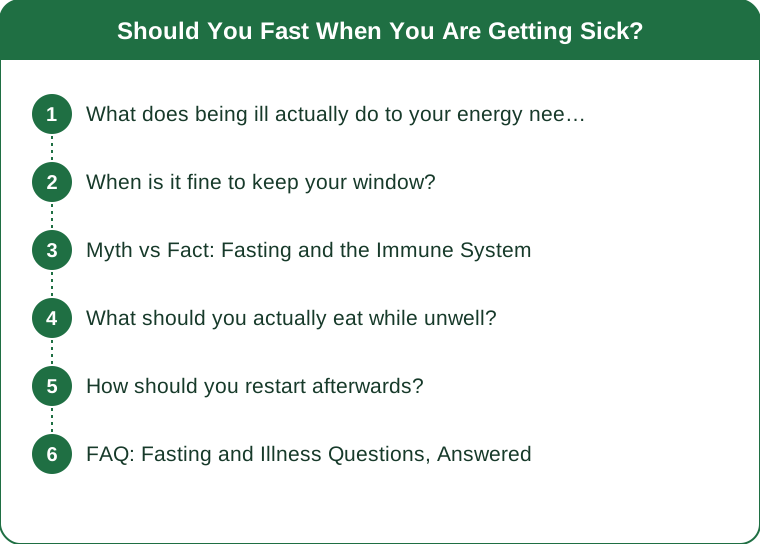
What does being ill actually do to your energy needs?
It raises them, sometimes substantially, at exactly the moment your appetite drops.
Fever is expensive. Basal metabolic rate rises roughly 10-13% for every degree Celsius above normal. A day at 38.5C costs you meaningfully more energy than a day at rest, and that is before the immune response itself.
The immune response has its own bill. Producing antibodies, mounting an inflammatory response, and repairing tissue all require amino acids. During infection the body will break down muscle protein to supply them if intake does not. This is why people lose lean mass during a week of flu and not just water.
Fluid losses climb. Fever, sweating, faster breathing, and a runny nose all add up, and if there is any vomiting or diarrhoea the figure goes up sharply.
So the picture is: higher energy need, higher protein need, much higher fluid need, and lower appetite. Adding a restriction window on top of that is asking your body to do a demanding job with less to work with.
When is it fine to keep your window?
There is a narrow case, and it is worth being specific about it.
Keep a normal window if: you have mild upper-respiratory symptoms only - a blocked nose, a mild sore throat, a bit of a headache - no fever, normal energy, and you are eating and drinking normally within your eating window.
Even then, apply two modifications. Shorten the fast to 12-14 hours rather than 16-18. And front-load fluids - the fasting window is where dehydration builds during illness, and being dehydrated makes every cold symptom worse and mucus thicker.
Do not keep the window if: you have a fever of any level, body aches, significant fatigue, any GI symptoms, or you have not been able to eat properly for a day. Also drop it if you are on a course of antibiotics that needs food, or on any medication with a food requirement.
One case people get wrong: feeling not hungry is not evidence that fasting is fine. Appetite suppression during infection is a symptom, not permission. It is the reason people undereat during illness in the first place.
Myth vs Fact: Fasting and the Immune System
Myth: Fasting boosts your immune system, so it helps you fight off an infection. Fact: The autophagy and immune-cell renewal effects people cite come from studies of prolonged fasting in healthy subjects, generally at baseline rather than during acute infection. The relevant question is not whether fasting has immune effects in general, it is whether restricting intake during an active infection helps - and the evidence does not support that it does.
Myth: Starve a fever, feed a cold. Fact: This is folk wisdom with no supporting evidence, and it inverts the actual metabolic picture. Fever is the situation with the highest energy demand.
Myth: Missing a couple of days ruins your fasting adaptation. Fact: Metabolic flexibility does not evaporate in a week. People consistently report getting back into their normal window within two or three days of feeling better.
Myth: Bone broth or a small amount of fat keeps you fasted. Fact: It keeps you in a low-insulin state, which is a different claim. During illness that distinction stops mattering - what you need is protein, fluid, and electrolytes, and broth is genuinely good for exactly that reason.

What should you actually eat while unwell?
Four priorities, roughly in order.
Fluids first, and with electrolytes. Plain water is not ideal when you are losing sodium through fever sweats. Broth, an oral rehydration solution, or diluted juice with a pinch of salt all work better. Aim for pale urine as the marker.
Protein, more than you think. Target something close to 1.2-1.6g per kg of body weight during illness. Eggs, yoghurt, fish, chicken, and dairy are the easiest when appetite is low. This is the intervention that most directly limits muscle loss.
Enough total energy that you are not in a deficit. This is not the week for a calorie target. If you are losing weight quickly during a five-day illness, most of it is fluid and lean tissue, neither of which is a win.
Small and frequent beats large and scheduled. When appetite is suppressed, three big meals fail. Six small ones succeed. This is, ironically, the exact opposite of a fasting structure, and it is the right structure for the week.
Zinc and vitamin C get a lot of attention here. The evidence for either shortening a cold meaningfully is modest at best, and neither substitutes for fluid and protein.
How should you restart afterwards?
Gradually, and later than you feel like.
Wait until you have been symptom-free for a full day, and until your appetite has come back on its own. Appetite returning is a reasonably good signal that the acute phase is over.
Restart at a shorter window than your usual. If you normally run 16:8, come back at 12:12 for two or three days, then 14:10, then back to normal. Going straight back to a long window after a week of poor intake is where people get lightheaded and conclude fasting stopped working for them.
Expect the first few days to feel harder than they used to. Sleep has usually been disrupted, glycogen is low, and hydration is often still catching up. None of this means anything about your metabolism.
Do not try to make up the deficit. There is nothing to make up. Eat normally, sleep, and let the week be an ordinary week.
One useful marker: if hunger during the fasting window feels sharp and distracting rather than a passing wave, you came back too fast. Drop back a step for another two days.
FAQ: Fasting and Illness Questions, Answered
Does coffee count while I am ill?
Black coffee will not break a fast in the technical sense, but it is a mild diuretic and it suppresses appetite - both unhelpful right now. One cup is fine; using it to get through the morning without eating is not.
What about a stomach bug specifically?
Different situation. With vomiting or diarrhoea, the priority is oral rehydration solution in small sips, and food when it is tolerated. Do not think about fasting windows at all until it has resolved.
I only get a cold once or twice a year. Is stopping really worth it?
Yes, and it costs you almost nothing. Three or four days off a fasting pattern has no measurable effect on any outcome you fast for, and it plausibly shortens the illness.
This is general information, not medical advice. Anyone with diabetes, on medication that requires food timing, pregnant, or with a history of disordered eating should get individual guidance before fasting at all, and particularly around illness.
TL;DR:
- Fever means stop. Immune response and fever both raise energy demand at the moment your intake drops.
- A mild, fever-free head cold is the only case for keeping a window - and shorten it to 12-14 hours.
- Priorities while unwell: fluids with electrolytes, then protein at 1.2-1.6g per kg, then enough total energy.
- Restart at a shorter window for a few days once you have been symptom-free for 24 hours.
Three days off a fasting pattern costs you nothing. Three days of restricting intake while your body is running an immune response costs you lean mass and probably a longer cold.
Keep Reading
This article is for general informational purposes only and is not medical advice. Always consult a qualified health professional for guidance specific to you.