Intermittent Fasting for Women: What the Hype Gets Wrong (and Right)
Intermittent fasting arrived with messianic marketing: effortless fat loss, cellular renewal, mental clarity — just stop eating breakfast. The honest version is more interesting: IF is a legitimate, research-supported eating pattern that some women thrive on and others should approach gently or skip entirely, because female hormones read fasting differently than the male bodies most early studies used. Here is the guide that respects both the science and your physiology. (Informational only — your doctor knows your specifics.)

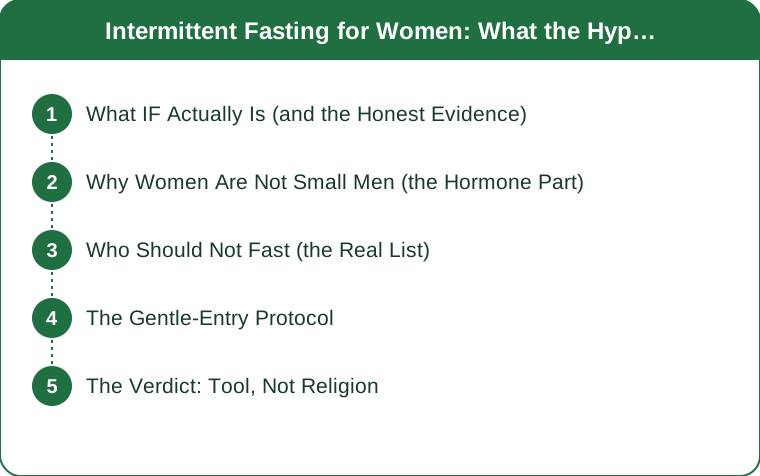
What IF Actually Is (and the Honest Evidence)
Intermittent fasting is scheduling, not starvation: compressing eating into a window — commonly 16:8 (16 hours fasted, 8 eating) or the gentler 14:10 or 12:12. What research supports: IF reliably helps some people eat less without counting, improves insulin sensitivity markers, and simplifies food decisions dramatically. What research does not show: magic beyond calories — matched studies find similar results to ordinary calorie awareness. IF’s true superpower is that some people find it easier. That is a legitimate superpower. It is just not sorcery.
Why Women Are Not Small Men (the Hormone Part)
Female physiology treats prolonged energy scarcity as data about environmental safety: fast too long or too aggressively, and some women experience the downstream memo — disrupted cycles, poorer sleep, hair shedding, irritability that deserves its own zip code. Research on aggressive fasting in women shows more mixed hormonal results than in men. None of this means IF is off-limits; it means women generally do better with shorter windows, gentler entries, and a firm rule: the moment your cycle, sleep or mood degrades, the experiment loses. Your body outranks the protocol.

Who Should Not Fast (the Real List)
IF is a hard no for: anyone with a history of disordered eating (fasting structures can reawaken restriction patterns — this is the most important sentence in this article), pregnant or breastfeeding women, and anyone underweight or under heavy training loads. It needs medical supervision alongside diabetes or blood-sugar medication. And it is simply a poor fit during seasons of high stress or terrible sleep — fasting is itself a mild stressor, and stacking stressors is how women end up wired, tired and blaming themselves for a protocol problem.
The Gentle-Entry Protocol
If you are cleared and curious, enter like a diplomat: start at 12:12 — finish dinner at 8pm, eat breakfast at 8am — which is barely fasting and mostly just retiring the midnight snack. After two comfortable weeks, try 14:10. Stay there; most women who love IF live at 14:10 or 15:9, and 16:8 is an option, not a promotion. Within the window: no compensatory bingeing required — normal meals, protein-forward, actual vegetables. Hydration is the whole game during fasting hours: water, black coffee, plain tea. Dizziness, cycle changes or sleep disruption mean widen the window, no ceremony needed.
The Verdict: Tool, Not Religion
The healthiest possible relationship with IF: it is one tool on a shelf of many — useful if it makes your eating simpler and calmer, worthless if it adds anxiety, hunger obsession or social gymnastics (skipping brunch with friends to honor an app timer is not health behavior). Some women genuinely flourish with a 14:10 rhythm. Others get identical results from three protein-anchored meals and no snacking after dinner — which, notice, is nearly the same thing without the branding. Judge it by one metric: does your life work better with it? Keep or discard accordingly.
Intermittent fasting for women, honestly summarized: real but modest benefits, hormone-aware caveats that deserve respect, and a gentle path — 12:12, then maybe 14:10 — for those cleared and curious. It is a scheduling tool, not a personality or a religion. If it simplifies your eating, welcome aboard. If it complicates your body’s signals, close the window and eat breakfast with a clear conscience. Both are winning moves.
Keep Reading
This article is for general informational purposes only and is not medical advice. Always consult a qualified health professional for guidance specific to you.