How to Handle Intermittent Fasting When Every Dinner Invite Falls Outside Your Window
Quick Answer: When social dinners regularly fall outside your usual eating window, the most sustainable fix is treating your fasting schedule as flexible rather than fixed — shifting your daily window earlier or later on social days, rather than skipping the dinner or feeling guilty through it, keeps the overall approach realistic enough to stick with long-term.
A fasting schedule that can’t flex around normal social life tends to get abandoned entirely within a few months — flexibility is what actually makes it sustainable.

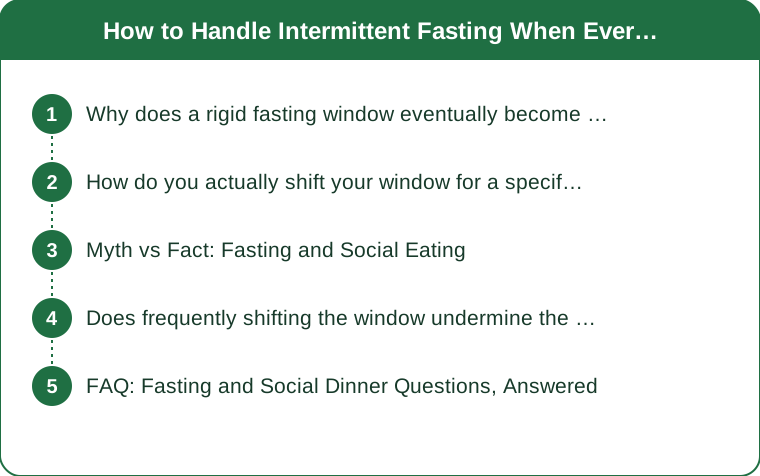
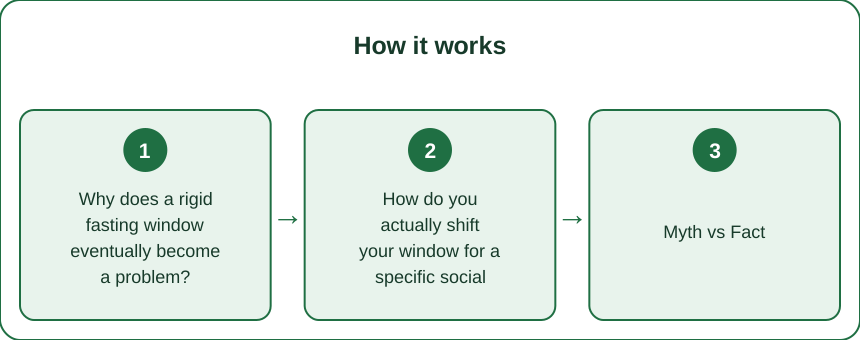
Why does a rigid fasting window eventually become a problem?
Most intermittent fasting approaches work by restricting the daily eating window, but real social life — dinner invites, work events, family gatherings — doesn’t reliably fall within any fixed window. Treating the schedule as completely non-negotiable means either regularly missing social events or regularly breaking the plan and feeling like a failure, both of which undermine long-term adherence more than an occasional shifted window ever would.
How do you actually shift your window for a specific social event without abandoning the approach?
If your usual window is, say, 12pm-8pm but a dinner invite is at 7:30pm running past 9pm, shift the entire window later that day (say, 2pm-10pm) rather than either skipping breakfast/lunch entirely to “make room” or eating dinner outside the window and feeling you’ve failed. This keeps the same total fasting duration for the day while accommodating the specific event — it’s a shift, not an abandonment of the structure.

Myth vs Fact: Fasting and Social Eating
Myth: You should always eat something small before a late dinner to stay in your window. Fact: This often just means eating twice as much overall — shifting the whole window is usually a cleaner solution than an extra small meal beforehand.
Myth: One shifted or broken window ruins your overall progress. Fact: Occasional flexibility has minimal impact on longer-term results; consistency over weeks and months matters far more than any single day’s exact timing.
Myth: You need to explain your eating schedule to people at social dinners. Fact: You can simply eat normally at a social dinner without announcing or justifying your usual schedule — nobody needs an explanation for what and when you’re eating.
Does frequently shifting the window undermine the benefits of intermittent fasting?
For most people practicing fasting for general health or weight management (not a specific medical protocol), occasional window shifts for social events have minimal impact on overall results, since total weekly eating pattern matters more than daily precision. If shifts become the norm most days of the week rather than occasional, that’s worth reassessing whether the chosen window actually fits your lifestyle, rather than continuing to force a mismatch.
FAQ: Fasting and Social Dinner Questions, Answered
Should you eat less at a social dinner to compensate for a shifted or wider window?
Not necessarily — eating normally at the social event and simply adjusting the following day’s window if needed is usually a more sustainable approach than restricting during the event itself.
Is it better to choose a different fasting schedule entirely if your social life is frequently unpredictable?
Yes, potentially — a shorter or more flexible daily window (or an approach based on weekly rather than daily eating windows) may fit an unpredictable social schedule better than a rigid daily window.
Does alcohol at a social dinner affect how you should handle the fasting window?
Alcohol has its own separate considerations (it affects blood sugar and can be easy to overconsume on an empty stomach) — breaking a fast with food rather than alcohol alone is generally the more comfortable approach.
TL;DR:
- A completely rigid fasting window tends to collide with normal social life eventually
- Shift the entire window on social days rather than skipping meals or feeling guilty
- Occasional shifts have minimal impact on overall results if consistency holds most days
- If shifts become the norm rather than the exception, the schedule itself may need adjusting
This is general information, not medical advice — check with a doctor before starting or adjusting a fasting routine, especially with existing health conditions.
Keep Reading
This article is for general informational purposes only and is not medical advice. Always consult a qualified health professional for guidance specific to you.