Why Intermittent Fasting Stops Producing Results After the First Few Months
Quick Answer: The plateau is predictable, not a failure. Four things stack up: your metabolic rate adjusts down to the lower intake, the early drop included one-time water and digestive-content changes that never repeat, your eating window quietly drifts looser over months, and your unconscious daily movement drops. The fixes, in order of payoff: audit your actual current habits against your original plan, add resistance training, vary the protocol, and re-track intake for two weeks. This is general information, not medical advice.
Month one: the scale moved, your clothes fit differently, you told everyone about it.
Month four: same 16:8 window, same discipline, and nothing has moved in six weeks.
You didn’t stop doing it right. The thing you were doing stopped being the same thing.

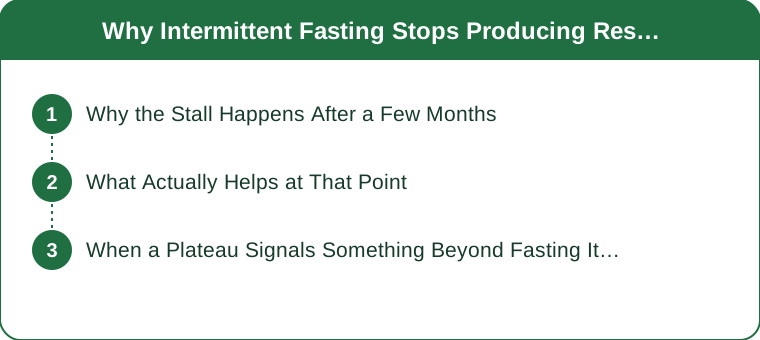
Why Did Intermittent Fasting Stop Working?
Four mechanisms, all documented, all ordinary.
Metabolic adaptation narrowed your deficit. Sustained lower intake nudges your metabolic rate down. The deficit that drove your first three months gradually shrinks — not to zero, but enough that the same behavior produces a smaller result. This is a general adaptation to reduced intake, not something unique to fasting.
Your early results were partly a one-time event. A big chunk of what happens in the first two weeks of a new eating pattern is water weight and digestive content shifting to a new equilibrium. It’s real, it’s visible, and it happens exactly once. Comparing month four to month one is comparing ongoing change to a one-time adjustment plus ongoing change.
Your eating window drifted, and you didn’t notice. This is the most common and most fixable cause. The window that started at noon now starts at 11:15 “sometimes.” The meal that was a real dinner became a real dinner plus whatever’s around at 7:30. Nobody notices this happening because it happens at about 90 seconds and 40 calories per week.
Your spontaneous movement went down. In sustained reduced-intake conditions, people unconsciously move less — less fidgeting, fewer stairs, shorter walks. It’s a documented compensatory response in broader caloric-restriction research, and it’s completely invisible from the inside. Your step count knows. You don’t.

What Actually Works to Break the Plateau?
1. Audit for drift first — it’s free and it’s usually the answer. Before changing anything, spend one week writing down actual window start and end times and actual meal content. Compare to what you think you’ve been doing. Most people find 30–45 minutes of window creep and a meaningful amount of untracked food. Fix that and you may not need anything else.
2. Add resistance training if you aren’t already lifting. This is the highest-value structural change on the list because it pulls a completely different lever than meal timing does. More muscle raises your metabolic rate around the clock, and it protects lean mass during a deficit. Two to three sessions a week, 45 minutes, compound movements. Fasting timing can’t do this no matter how you arrange the hours.
3. Vary the protocol instead of assuming one window works forever. The same periodization logic that applies to training applies here. If you’ve run 16:8 for four months, try 14:10 for a few weeks, or shift the window earlier in the day. The point isn’t that one schedule is magic — it’s that a fixed stimulus produces diminishing adaptation.
4. Re-track precisely for two weeks. Not forever. The eating window controls when, and does nothing at all about what or how much. Two weeks of honest tracking recalibrates your sense of portions, which drifts as reliably as the window does.
Myth vs Fact
Myth: A plateau means you should fast harder — go from 16:8 to 20:4, or add fasted days. Fact: Escalating usually backfires. Longer fasts tend to increase compensatory eating in the window and further reduce spontaneous activity, which is exactly the mechanism that caused the plateau. Escalation is the intuitive move and roughly the last one to try.
Myth: Metabolic adaptation means your metabolism is “damaged.” Fact: It’s an adjustment, not damage, and it’s largely reversible. Rates come back up as intake and activity come back up. The internet’s favorite phrase for this is not a diagnosis.
Myth: If the window is right, what you eat inside it doesn’t matter. Fact: This one has cost a lot of people a lot of months. The window is a timing tool. It has no opinion about content, and content still determines most of the outcome.
What Else Could Be Blocking Progress?
Two factors operate entirely outside fasting mechanics and can flatten progress regardless of how well you run the protocol:
Chronic under-sleeping. Insufficient sleep over weeks disrupts the same appetite-regulating hormones that fasting timing is meant to influence. You can run a perfect window on six hours of sleep and get very little for it. If you’re sleeping under seven hours most nights, that’s a bigger lever than any window adjustment.
Chronic stress. Sustained elevated cortisol influences how and where the body stores energy, and it operates alongside your eating pattern rather than being fixed by it. High-stress periods are genuinely bad times to expect a plateau to break.
And the honest one: if you’ve ruled out drift, sleep, and stress, and the plateau holds — that may be a reasonable place to stop chasing the original number rather than escalating further. A weight your body maintains comfortably on a sustainable pattern is a legitimate outcome, not a failed one.
When to see a professional: if a plateau comes with fatigue, hair loss, cold intolerance, or menstrual changes, see your provider — those can point to thyroid or hormonal issues, or to under-eating. Anyone with diabetes, on blood-sugar or blood-pressure medication, with a history of disordered eating, or who is pregnant should not be adjusting fasting protocols without medical supervision. This is general information, not medical advice.
Mini FAQ
How long is “a plateau” before it counts?
Four to six weeks of no change while your habits are genuinely consistent. Two weeks is noise — normal fluctuation in water and digestive content easily masks real change over that span.
Should I take a break from fasting entirely?
A 2–4 week return to normal eating at maintenance can help, particularly if you’ve been in a deficit for many months. It’s not a setback; it gives the adaptations room to reverse before you start again.
Does coffee or anything else break my fast?
Black coffee, plain tea, and water don’t meaningfully affect it. Anything with calories does. That said, if you’ve plateaued, your splash of cream is almost certainly not the reason — look at window drift and total intake first.
TL;DR:
- Plateaus come from metabolic adaptation, one-time early water loss, unnoticed window drift, and reduced spontaneous movement.
- Audit your real current habits for a week before changing anything — drift is the most common cause.
- Add resistance training: it’s the only item here that pulls a genuinely different lever.
- Don’t escalate to longer fasts; that usually deepens the compensation.
- Check sleep and stress, and see a provider for fatigue, hair loss, or cycle changes.
Keep Reading
This article is for general informational purposes only and is not medical advice. Always consult a qualified health professional for guidance specific to you.