Fasted Workouts: Empowering, Overrated, or Just Scheduling?
Quick Answer: Fasted training burns more fat during the session, but 24-hour fat balance evens out — body-composition studies show no meaningful long-term advantage. Easy movement fasted is fine for most people. Hard strength work and intervals perform measurably better fed, and even a banana 20 minutes beforehand helps. For women, intense fasted sessions warrant more caution than the internet suggests.
Fasted cardio comes with a mythology attached: train before breakfast, burn pure fat, unlock some secret level of leanness the fed people never reach.
The research says something considerably less cinematic. And for women specifically, the fine print matters more than the headline does.

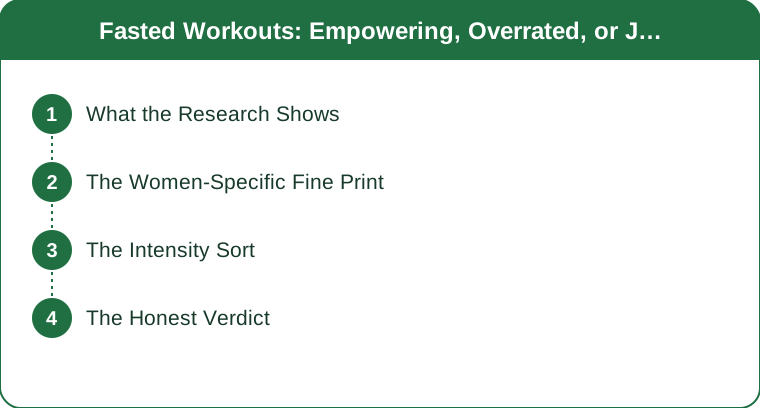
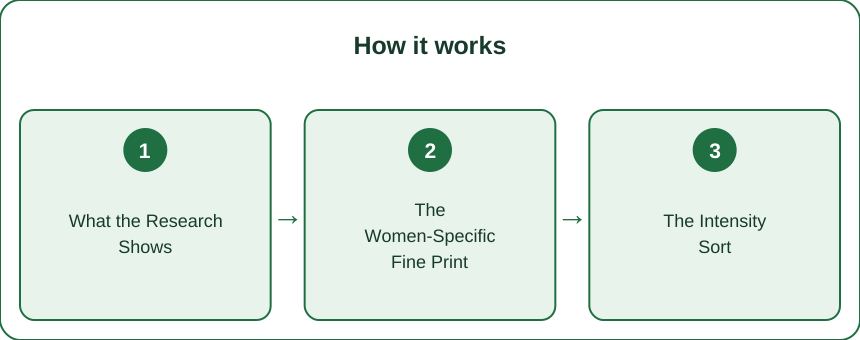
Does Fasted Cardio Actually Burn More Fat?
During the session, yes. Over the day, it evens out.
With no recent meal, your body has less circulating glucose available, so a larger share of the fuel used during that workout comes from fat. That part of the myth is true and measurable.
What happens next is the part that gets left out. Your body settles its energy accounts across the full 24 hours, not workout by workout. Burn more fat at 7am and you burn correspondingly less later — the daily total lands in essentially the same place.
Body-composition studies comparing fasted and fed training over several weeks, with calories matched, consistently find no meaningful difference in fat loss. The variable that actually predicts results is total energy balance over time.
So fasted training isn’t wrong. It’s just a preference, not a cheat code.
What’s the Women-Specific Fine Print?
Female physiology appears to read energy availability quite attentively, and that’s worth taking seriously without overstating it.
For some women, repeated hard training in a fasted state stacks a physiological stressor on top of whatever else is going on. The signals people report are fairly consistent: disrupted or lighter cycles, unusual fatigue, poor recovery between sessions, and hunger that goes strange rather than increasing.
Easy fasted movement — a walk, gentle yoga, low-intensity cycling — sits fine for most people and there’s no particular reason to avoid it.
Intense fasted training is where the skepticism belongs. If you’re doing hard intervals or heavy lifting several times a week and also fasting through them, that’s a combination worth watching for the signals above.
This is general information rather than individual advice. If your cycle changes, if fatigue becomes persistent, or if you have any history of disordered eating, this is a conversation for a doctor or a registered dietitian rather than an article.

Which Workouts Are Fine Fasted and Which Aren’t?
Sort by intensity, not by type.
Fasted-friendly:
- Zone 2 walks and easy jogs, 30 to 60 minutes
- Gentle yoga or mobility work
- Light, technique-focused sessions
- Anything you’d describe as “could hold a conversation throughout”
Better fed:
- Heavy strength work
- High-intensity intervals
- Sessions over about 75 minutes
- Anything where you’re chasing a specific number
The performance gap on hard sessions is real and fairly consistent. Even a banana 20 to 30 minutes beforehand measurably lifts output — more reps completed, better power on later intervals, less of a wall at the end.
That’s not a small thing. Better output means better training stimulus, which is the actual driver of results.
Myth vs Fact: Fasted Training
Myth: Fasted cardio burns more body fat overall. Fact: It burns more fat during the session, but 24-hour fat balance equalizes. Matched-calorie studies show no long-term composition advantage.
Myth: Eating before a workout “wastes” the fat-burning window. Fact: There’s no window to waste. Total energy balance over days and weeks is what determines fat loss, not fuel source during any single hour.
Myth: Fasted training builds more muscle by boosting growth hormone. Fact: The hormonal fluctuations are real but small and short-lived. Training fed generally produces more volume and better recovery, which matters far more for muscle.
Myth: If you’re not hungry, fasted must be right for you. Fact: Morning appetite is a poor proxy for whether you have fuel available. Plenty of people aren’t hungry at 6am and still perform noticeably better with something small beforehand.
How Should You Actually Schedule It?
Start from your life, not from the theory.
If pre-breakfast is your only reliable slot, take it. The best workout is unambiguously the one that happens, and a fasted session you’ll actually do beats a fed session you keep postponing. Just match the intensity to the empty tank — keep it easy to moderate, drink water, and have breakfast ready for afterward.
If you’re training hard, eat something first. A banana, a slice of toast with honey, or a small yogurt 20 to 30 minutes out is enough. It doesn’t need to be a meal.
And watch your own signals over a few weeks. Energy through the session, recovery the next day, sleep, cycle regularity, and appetite are all more informative than any general rule — including this one.
Mini FAQ
Should women do fasted cardio?
Easy fasted movement is fine for most women. Intense fasted training more often produces fatigue, recovery problems, or cycle changes, so it’s worth approaching carefully and watching for those signals.
What should you eat before an early morning workout?
Something small and mostly carbohydrate, 20 to 30 minutes ahead — a banana, toast with honey, or a few dates. Enough to lift performance without sitting heavily in your stomach.
Is it bad to lift weights on an empty stomach?
Not harmful for most people, but performance is typically lower — fewer reps and less power late in the session. Since training volume drives strength and muscle gains, eating something first is usually the better trade.
TL;DR:
- Fasted burns more fat during the session; 24-hour totals even out. No long-term advantage in the research.
- Easy movement fasted is fine. Hard strength work and intervals perform better fed.
- A banana 20-30 minutes beforehand measurably improves output on hard sessions.
- Women should watch for cycle changes, persistent fatigue, and poor recovery with intense fasted training.
- The best timing is the one you’ll actually keep — match intensity to available fuel.
Train when life allows, feed the hard stuff, and let the myth keep its cinema.
Keep Reading
This article is for general informational purposes only and is not medical advice. Always consult a qualified health professional for guidance specific to you.