Fasting and the Hunger Signals Worth Not Overriding
Quick Answer: Most hunger during a fasting window is habitual - it arrives at your usual meal times, peaks for about twenty minutes and passes. That kind is safe to sit with. A different set of signals should not be overridden: light-headedness on standing, shakiness with cold sweat, difficulty concentrating that does not clear, escalating rather than waving hunger, and irritability that affects other people. The distinction is whether the signal passes or builds.
The standard advice is that hunger comes in waves and you should ride them out.
That is true for most hunger and it is not true for all of it, and the advice rarely says which is which.
Here is the line.
This is general information, not medical advice.

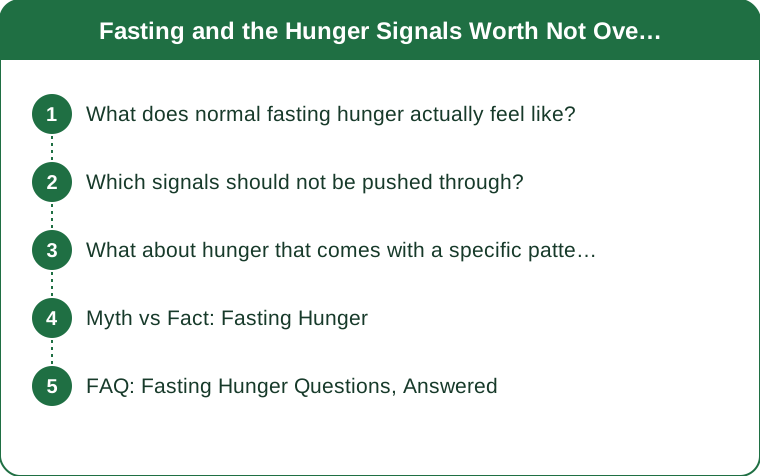
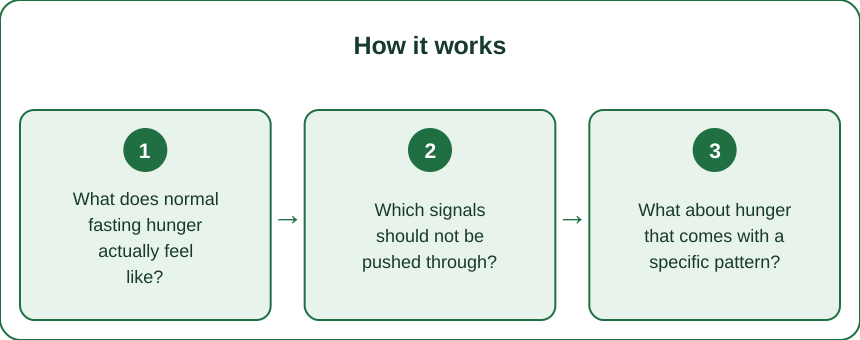
What does normal fasting hunger actually feel like?
It comes, it peaks, and it goes - usually within twenty minutes.
The wave pattern is the defining feature. Ghrelin, the main hunger-signalling hormone, is released in pulses rather than continuously, and those pulses are strongly conditioned by habitual meal timing. Which is why hunger arrives at the time you usually eat rather than when your body needs fuel.
A normal wave looks like this: it builds over a few minutes, reaches an uncomfortable but manageable peak, and subsides. If you are distracted through the peak you often do not notice it end.
Practical markers that a hunger episode is the ordinary kind:
- It arrives close to a usual meal time
- It fades within about twenty minutes whether or not you eat
- It responds to water, black coffee or activity - not because those are meals but because they interrupt the pattern
- It does not come with physical symptoms beyond the stomach sensation
And the reassuring finding for people starting out: habitual hunger at old meal times reduces substantially over the first one to two weeks as the conditioned timing adjusts. The first week is not representative of what fasting feels like.
This is the hunger the standard advice is about, and the standard advice is right about it. It is not the whole picture.
Which signals should not be pushed through?
The ones that build rather than wave, and the ones with physical symptoms attached.
Light-headedness on standing. This is a blood pressure and hydration signal, not a hunger signal, and it is one of the most common reasons fasting goes wrong. Often it is electrolytes rather than food - but it should stop the fast being treated as a test of willpower and start it being treated as something to address.
Shakiness with cold sweat. Distinct from ordinary hunger, and it warrants attention. In anyone taking glucose-lowering medication this is urgent and the fast should be broken immediately - this is not a grey area.
Cognitive impairment that does not clear. Some difficulty concentrating in the first week is common and adapts. Persistent inability to think clearly, particularly if you need to drive or work, is a signal to eat.
Escalating hunger rather than waving hunger. The wave pattern is the normal one. Hunger that steadily builds over an hour or more without a peak is a different signal and generally means the fast has gone past what your current state supports.
Heart racing or palpitations. Sometimes electrolyte-related, sometimes not. Either way it is a reason to stop and, if repeated, a reason to see a doctor.
Irritability that affects the people around you. Not a medical emergency and worth taking seriously anyway - it is a reliable signal that the current window is not sustainable, and the cost is being paid by other people.
The unifying principle: normal fasting hunger is uncomfortable and it does not come with systemic symptoms. Once there are systemic symptoms, you are no longer testing discipline.

What about hunger that comes with a specific pattern?
Three patterns worth reading rather than pushing through.
Hunger that is worse than usual on a particular day. The common causes are poor sleep, a hard training session the previous day, or a genuinely inadequate previous eating window. Sleep restriction affects appetite-regulating hormones, so a bad night reliably produces a hungrier day. On those days, shortening the fast is the correct response rather than a failure.
Hunger that is much worse at a specific point in the menstrual cycle. Appetite and energy requirements shift across the cycle, and the luteal phase in particular is commonly associated with increased hunger. Applying an identical fasting window across the whole month ignores a real physiological change. Many women do better with a shorter window in the late luteal phase, and treating that as flexibility rather than failure is what makes the practice last.
Hunger that started only after you increased training. This is a fuelling signal. If training volume went up and the eating window did not, the hunger is doing its job. The answer is more food in the window, not more discipline in the fast.
A fourth worth mentioning because it is so often misread: hunger that is really thirst or caffeine withdrawal. Both are common in the first two weeks and both respond to the obvious fix. Water first, and if you cut coffee at the same time you started fasting, you have two adaptations running at once and no way to tell which is producing what.
The general skill here is asking what changed before deciding whether to override. Hunger that is different from your normal pattern usually has a cause, and the cause is usually not weakness.
Myth vs Fact: Fasting Hunger
Myth: Pushing through hunger builds discipline and it gets easier. Fact: Habitual hunger does reduce over one to two weeks as meal timing conditioning adjusts. Hunger with physical symptoms does not become safe by being repeated, and treating the two the same is the main way people get hurt.
Myth: If you are hungry, your body needs food right now. Fact: Most fasting hunger is conditioned timing rather than a fuel requirement, which is exactly why it arrives on schedule and passes without eating.
Myth: Feeling shaky is just part of it. Fact: Shakiness with cold sweat is a signal to stop, particularly for anyone on glucose-lowering medication. It is not a stage to push through.
Myth: Breaking a fast early ruins the benefits. Fact: Consistency over weeks matters far more than any single window. A fast broken two hours early on a bad day costs essentially nothing; a practice abandoned after a bad experience costs everything.
Myth: The same window should work every day. Fact: Sleep, training load, illness and cycle phase all change requirements. A fixed window applied to a variable life is the most common reason fasting stops working after a few months.
Myth: Black coffee makes hunger worse. Fact: Coffee tends to blunt appetite acutely for most people. What it can do is disrupt sleep if taken late, which produces a hungrier day tomorrow - an indirect effect that gets misattributed.
FAQ: Fasting Hunger Questions, Answered
How long does the first-week hunger last?
Usually one to two weeks before habitual hunger at old meal times reduces noticeably. The first few days are the worst and are not representative of what the practice feels like once adjusted.
Is it normal to feel light-headed?
Briefly on standing, occasionally, and it is worth addressing rather than accepting. It is often hydration or electrolytes rather than food, and repeated or severe light-headedness is a reason to stop and speak to a doctor.
Should I break the fast if I am hungry before a workout?
If you are training hard, yes - eat. Fasted training suits some people for easy sessions and generally impairs hard ones. Hunger before a demanding session is a fuelling signal rather than a test.
Does hunger mean fat burning is happening?
No. Hunger is a hormonal signal about timing and food availability, not a readout of what your metabolism is doing. The two are not connected in the way the popular framing suggests.
What if I am hungry all the time, not in waves?
That pattern suggests the eating window is not providing enough food, or that sleep, stress or training load has changed. Constant rather than waving hunger is a signal to look at what is going into the window rather than to tighten the fast.
When should I talk to a doctor?
Before starting if you take any medication - particularly glucose-lowering medication - are pregnant or breastfeeding, or have a history of disordered eating. During, if you get repeated light-headedness, palpitations, or persistent cognitive difficulty.
TL;DR:
- Normal fasting hunger comes in waves, peaks in about twenty minutes and passes whether or not you eat
- Signals not to override: light-headedness on standing, shakiness with cold sweat, unclear thinking that does not resolve, building rather than waving hunger, palpitations
- Anyone on glucose-lowering medication should treat shakiness as a stop signal, not a stage
- Unusually hungry days usually have a cause - poor sleep, a hard session, cycle phase, or an under-fed window
- Adjusting the window on a bad day protects the practice; forcing it is what ends it
- Constant hunger means the eating window is too small, not the fast too short
The skill is not pushing through. It is knowing which signal you are looking at.
Keep Reading
This article is for general informational purposes only and is not medical advice. Always consult a qualified health professional for guidance specific to you.