Why Your Morning Coffee Hits Different When You're Fasting
Quick Answer: Caffeine on an empty stomach absorbs faster and peaks harder because there’s no food slowing gastric emptying — that’s why your usual cup suddenly feels like two. Pushing your first sip to an hour into your fasting window, and capping it before noon, smooths the curve without giving up coffee.
Same mug, same beans, same amount — but your 7am fasted coffee hits like a shot of espresso while your fed version barely registers. You’re not imagining it, and it’s not really about willpower.

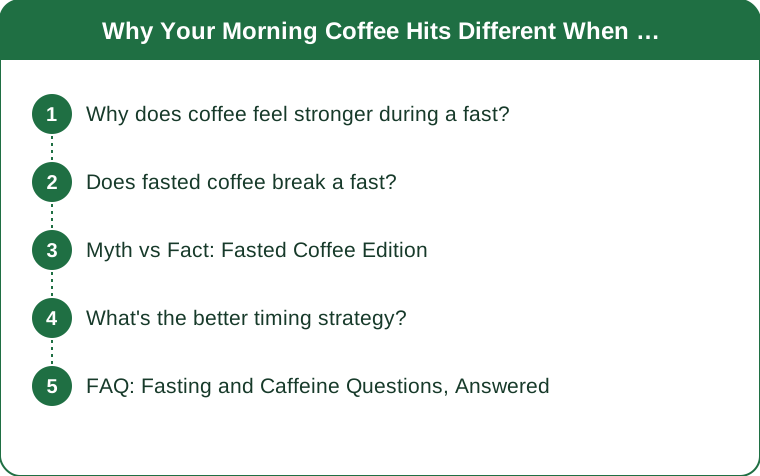
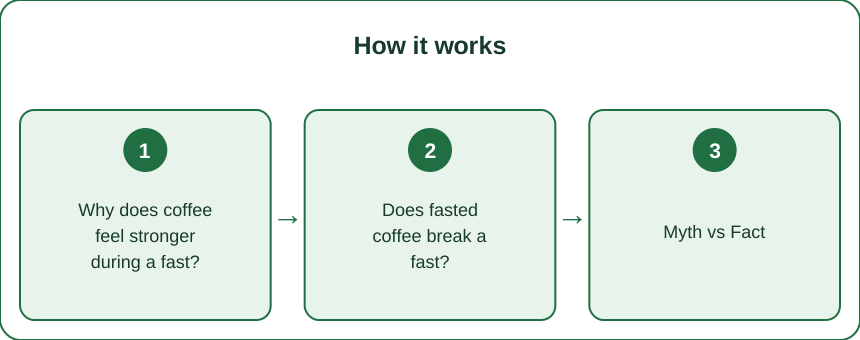
Why does coffee feel stronger during a fast?
With nothing in your stomach, caffeine clears the gut wall and hits your bloodstream in as little as 15 minutes, versus 30-45 when food is present to slow things down.
That faster absorption means a sharper spike — more alertness, but also more of the jitters, racing heart, or stomach acid burn that fasted drinkers report. Your liver is also busy mobilizing stored glucose for fuel, so caffeine’s cortisol bump stacks on top of an already-active stress response.
Does fasted coffee break a fast?
Black coffee, plain tea, and water don’t meaningfully break a fast — under roughly 10-15 calories, insulin barely moves. The moment cream, sugar, or a splash of milk enters, you’ve technically started eating.
The real question isn’t calories, though — it’s comfort. If fasted coffee gives you stomach pain or the shakes, the fasting-purity debate is moot; your body is telling you to adjust timing, not push through.

Myth vs Fact: Fasted Coffee Edition
Myth: More coffee = more fat burning while fasted. Fact: caffeine gives a mild, short-lived metabolic bump (~3-4%) regardless of fasted state — doubling your intake doesn’t double the effect, it just doubles the jitters.
Myth: Fasted coffee always causes anxiety. Fact: it’s dose- and timing-dependent. Most people tolerate 1 cup fine; the second cup before 9am on an empty stomach is where the complaints start.
Myth: Decaf defeats the purpose. Fact: if you love the ritual but not the crash, decaf keeps the fast-friendly habit without the caffeine spike — a legitimate swap, not a cop-out.
What’s the better timing strategy?
Wait 60-90 minutes after waking before your first cup — cortisol is naturally elevated right at wake-up, and stacking caffeine on top of that peak is what produces the worst jitters.
From there: 1 cup mid-fast, black or with a splash of unsweetened almond milk if that stays under your fasting threshold, finished by early afternoon so it doesn’t interfere with your eating-window sleep.
FAQ: Fasting and Caffeine Questions, Answered
How many cups of coffee can I have while fasting?
Most people tolerate 1-2 cups of black coffee comfortably during a fast. Past that, jitters and stomach irritation tend to outweigh the alertness benefit.
Why do I get a headache if I skip fasted coffee?
That’s usually caffeine withdrawal, not fasting itself — your body expects the dose at a certain time. A slightly earlier, smaller cup usually resolves it.
Is fasted coffee worse for anxiety-prone people?
Often yes — the faster absorption amplifies caffeine’s stimulant effect. If you’re prone to anxiety, try having coffee with a small amount of fat (like a splash of milk) even if it nudges your fast, to blunt the spike.
TL;DR:
- Fasted coffee hits harder because empty-stomach absorption is faster, not because you’re doing anything wrong
- Black coffee/tea won’t break a fast; cream and sugar will
- Wait 60-90 minutes after waking to avoid stacking on your natural cortisol peak
- 1-2 cups, finished by early afternoon, is the sweet spot for most people
If your usual cup feels like too much lately, it’s not your tolerance dropping — it’s just fasting doing what fasting does.
Keep Reading
This article is for general informational purposes only and is not medical advice. Always consult a qualified health professional for guidance specific to you.