Coffee and Fasting: What Actually Breaks the Window (and What Never Did)
Quick Answer: Black coffee does not meaningfully break a fast for the reasons most people fast - it has 2 to 5 calories, does not raise blood sugar or insulin in any practical sense, and may mildly increase fat burning and blunt appetite. A real splash of milk (around 15 to 30 calories) is a technical break but a trivial one for weight-focused fasting; it matters more for strict metabolic or gut-rest protocols. Where coffee actually sabotages fasting is elsewhere: too late in the day, wrecking sleep, or as a hunger-mask that lets the eating window collapse into one giant meal.
One site says coffee ends your fast at the first sip. Another says bulletproof coffee with two tablespoons of butter is fasting. They cannot both be right, and the confusion has a simple source: nobody defined what the fast is for before ruling on the coffee.

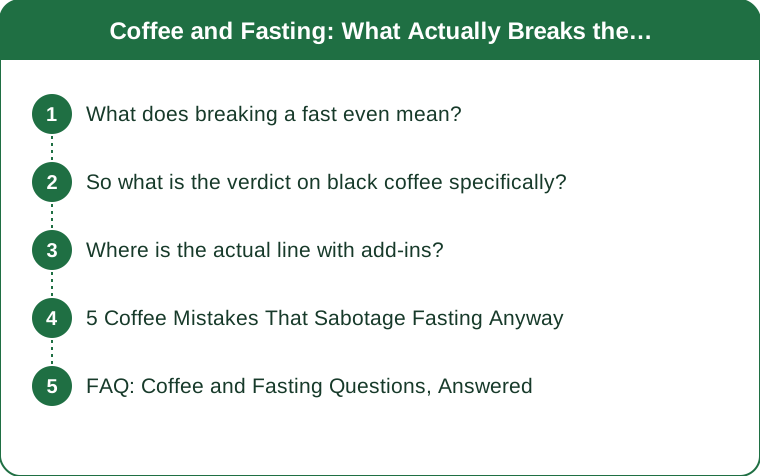
What does breaking a fast even mean?
It depends entirely on why you are fasting, which is why the internet disagrees.
If the goal is calorie control - the most common reason - breaking a fast means consuming enough energy to matter. The mechanism behind most intermittent fasting results is simply eating less because the eating window is smaller. Against that goal, a 3-calorie black coffee is arithmetic noise, and treating it as a violation misunderstands why the method works.
If the goal is insulin and blood sugar management, breaking a fast means triggering a meaningful insulin response. Black coffee does not do this to any practical degree. Trivial protein or fat - a splash of milk - produces a minimal response; a caramel latte with syrup and whipped cream produces a full one. The dose is the entire story.
If the goal is autophagy or strict metabolic fasting - the cellular-cleanup rationale behind longer fasts - the honest answer is that human data on exact thresholds is thin. Purists take everything but water as a risk; pragmatists note that black coffee has been associated with promoting, not suppressing, the relevant pathways in the available research. Nobody can give you a calorie cutoff with real confidence, so strict protocols default to strict.
If the goal is gut rest before a medical test, follow the medical instructions - full stop. Fasting for bloodwork or a procedure has its own rules, and your care team’s instructions override every wellness framework.
The practical takeaway: decide which fast you are actually running. For the calorie-control fast that most people mean, the coffee question nearly evaporates. This is general information, not medical advice.
So what is the verdict on black coffee specifically?
About as close to a free pass as fasting offers - with two genuine caveats.
The calorie math is trivial. Plain brewed coffee runs 2 to 5 calories per cup from trace dissolved compounds. Espresso, americanos, cold brew, and plain iced coffee are all in the same range. No practical fasting framework fails over single-digit calories.
The metabolic effects lean in fasting’s favor. Caffeine modestly increases fat oxidation and energy expenditure for a couple of hours, and coffee reliably blunts appetite for many people - which is precisely why the morning cup makes the fasting window easier rather than harder. Chlorogenic acids in coffee are also being studied for glucose-handling effects, mostly favorable in direction.
Caveat one: coffee on a fully empty stomach disagrees with some bodies. Acid reflux, urgency, jitteriness, or nausea in the first fasting hours are common enough. Fixes that keep the fast intact: a full glass of water first, a smaller or later cup, cold brew (lower acidity), or a lighter roast spread over more time.
Caveat two: the cortisol-and-anxiety angle is about dose and timing, not fasting. Caffeine raises cortisol modestly - fasting does not change this materially - but stacking a large cold brew on an empty stomach at 6am can feel harsher than the same drink with food. If fasting mornings feel wired and unpleasant, halve the dose before abandoning the schedule.
Tea, for completeness, gets the same pass. Plain black, green, or herbal tea is calorically nothing and appetite-friendly. Sparkling water too. The entire plain-bitter-beverage aisle is fasting-compatible, which is worth knowing on the days coffee itself is the problem.

Where is the actual line with add-ins?
Sorted from harmless to fast-ending.
Effectively free: cinnamon, a squeeze of lemon, salt. Zero-to-trace calories, no insulin story. Salt in early-fast coffee is actually functional for longer fasts, where sodium dips cause the headaches people blame on hunger.
Trivial but technical: a real splash of milk or cream. One tablespoon of whole milk is about 9 calories; of half-and-half, about 20. For calorie-control fasting, this is rounding error - the pragmatic position is that a 16:8 schedule with a splash of milk that you actually sustain beats a purist schedule you quit in February. For strict metabolic protocols, it is a technical break: dairy protein produces a measurable, if small, insulin response. Know which fast you are running and rule accordingly.
The gray zone people pretend is clear: zero-calorie sweeteners. Metabolically near-silent in most studies - minimal glucose or insulin response for the common ones. The honest concern is behavioral: sweet taste on an empty stomach ramps some people’s appetite and cravings, making the window harder. Self-experiment: if diet soda or sweetened coffee makes 11am hungrier, that is your answer regardless of the biochemistry.
Clearly breaks the fast, on purpose: butter and MCT coffee. Two tablespoons of butter is around 200 calories. Bulletproof-style coffee is not fasting - it is a high-fat liquid breakfast that keeps insulin low. That has its own logic in keto frameworks, but calling it a fast confuses two different tools. If your goal is calorie control, 200 drinkable calories that provide no fullness is close to the worst trade on the menu.
And obviously: the latte-with-syrup category. A flavored 16-ounce milk drink is 250 to 400 calories of breakfast. Nobody is confused about this one; it just gets ordered on autopilot. The fix is ordering vocabulary, not willpower - americano with a splash is the phrase that keeps the morning ritual and the fast simultaneously.
5 Coffee Mistakes That Sabotage Fasting Anyway
1. Letting coffee push the first meal too far. Coffee’s appetite suppression is strong enough that some people slide from a 16-hour fast into an accidental 20-hour one, then inhale a giant chaotic meal at 4pm and sleep badly. The window exists to structure eating, not to be stretched until you snap. Eat at the planned time even if coffee says you could hold out.
2. Caffeine after 2pm. With a five-to-six-hour half-life, a 3pm cup is still a quarter-dose in your system at 9pm. Fasting schedules already ask the body for adaptation; fragmenting sleep on top measurably worsens hunger hormones the next day - ghrelin up, satiety down - making tomorrow’s window harder. The afternoon cup literally makes you hungrier tomorrow.
3. Replacing water with coffee. Coffee is mildly hydrating on net, but four cups and no water is a dehydration pattern with a fasting headache attached. During long morning windows, the ratio that works: one glass of water alongside or before each coffee, and salt on the first meal.
4. Using coffee to white-knuckle a window that is too long. If the schedule only survives on three espressos and clenched teeth, the schedule is wrong, not you. A 14:10 or 12:12 pattern held comfortably for months beats an 18:6 held heroically for three weeks. Caffeine should smooth a reasonable plan, not disguise an unreasonable one.
5. The empty-stomach jitters spiral. Caffeine hits harder and faster with nothing in the stomach - sharper peak, shakier hands, and for some people a blood-sugar-adjacent wobbly feeling that gets misread as I must break my fast immediately, followed by an unplanned pastry. If that loop sounds familiar: half the dose, add water first, or move the first cup an hour later. The fast was never the problem; the dose was.
FAQ: Coffee and Fasting Questions, Answered
Does black coffee break a fast?
For calorie-control and insulin-focused fasting - the reasons most people fast - no. At 2 to 5 calories with no practical insulin response, black coffee leaves those fasts intact, and its appetite-blunting effect usually makes the window easier. Only the strictest metabolic protocols and medical pre-test fasts treat it as a break.
Can I put milk in my coffee while fasting?
A genuine splash - a tablespoon or so, 10 to 20 calories - is a technicality that does not undermine weight-focused fasting, and sustaining your schedule matters more than purity. It does count against strict metabolic fasting, since dairy protein triggers a small insulin response. A milky 12-ounce latte is a different object: that is breakfast.
Do zero-calorie sweeteners break a fast?
Metabolically, mostly no - common sweeteners show minimal glucose or insulin effects in most people. Behaviorally, they can backfire: sweet taste on an empty stomach ramps appetite for a subset of people. Run a one-week self-test; if sweetened drinks make late morning hungrier, drop them on fasting mornings.
Why does coffee make me feel shaky when fasting?
An empty stomach speeds caffeine absorption, producing a sharper peak - jitters, racing heart, and a wobbly feeling that mimics low blood sugar. Halve the dose, drink water first, choose cold brew or a lighter roast, or delay the first cup an hour. If shakiness persists or comes with other symptoms, get it checked rather than pushing through. This is general information, not medical advice.
TL;DR:
- Define the fast first: calorie control, insulin management, strict metabolic, or medical - the coffee ruling changes with the goal.
- Black coffee passes every practical test and usually makes the window easier.
- A splash of milk is trivial for weight-focused fasting, technical for strict protocols. Butter coffee is breakfast.
- Sweeteners are metabolically quiet but behaviorally loud for some - self-test.
- The real sabotage is timing: caffeine after 2pm wrecks sleep, and bad sleep raises tomorrow’s hunger.
The question was never really about the coffee. Decide what your fast is for, and the cup rules on itself.
Keep Reading
This article is for general informational purposes only and is not medical advice. Always consult a qualified health professional for guidance specific to you.